
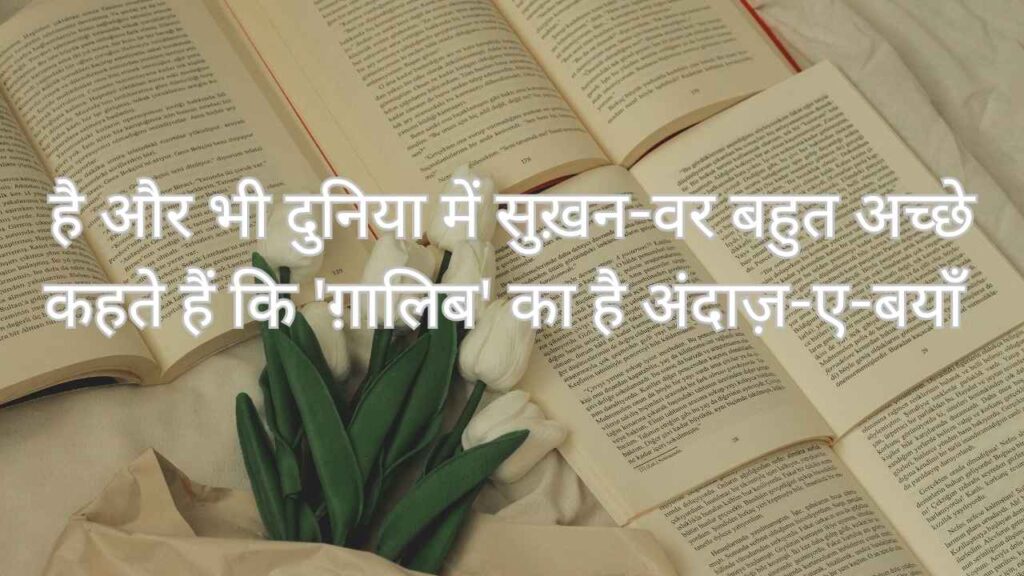
है और भी दुनिया में सुख़न-वर बहुत अच्छे
कहते हैं कि ‘ग़ालिब’ का है अंदाज़-ए-बयाँ और
Hai aur bhi duniya mein sukhan-war bahut achche
Kahte hain ki ‘Ghalib’ ka hai andaaz-e-bayaan aur
TRANSLATION
There are many other fine poets in the world; but people say that Ghalib’s manner of expression is something else entirely.
EXPLANATION
This is the closing couplet (maqta) of a ghazal, the verse in which the poet traditionally names himself, and here Ghalib uses that convention to make one of the most quietly arrogant statements in literature. He begins generously: yes, there are many excellent poets in the world. “Sukhan-war” means a master of speech, an eloquent one.
But the second line pivots with masterful misdirection. He does not directly praise himself — he attributes the praise to others: “kahte hain,” people say. By putting the compliment in the mouths of “people,” Ghalib distances himself from the boast even as he delivers it, which makes the self-praise both modest in form and devastating in effect.
The key word is “aur” at the very end — literally “other” or “more,” but here meaning something like “in a class of its own,” “different,” “beyond comparison.” Ghalib does not claim to be better in degree; he claims his style is different in kind. Other poets can be ranked against one another; he stands outside the ranking altogether.
There is delicious irony in the structure. He concedes that others are “bahut achche,” very good, but then dismisses the whole category of “very good” as beside the point when it comes to him. It is the confidence of an artist who knows that comparison is the wrong frame for what he does.
History, of course, vindicated the boast completely, which is part of why the couplet is so beloved. When a poet declares his own uniqueness and then turns out to be right, the line acquires a prophetic glow. Today it is quoted not only about Ghalib but as a template whenever someone wants to assert, with a wink, that they are simply built differently.