
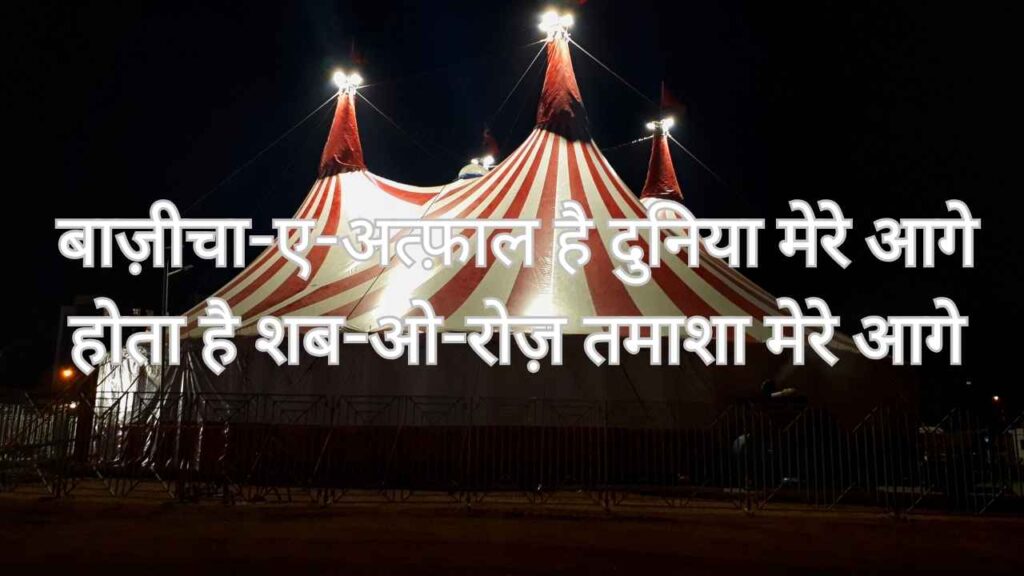
बाज़ीचा-ए-अत्फ़ाल है दुनिया मेरे आगे
होता है शब-ओ-रोज़ तमाशा मेरे आगे
Baazeecha-e-atfaal hai duniya mere aage
Hota hai shab-o-roz tamaasha mere aage
TRANSLATION
The world is no more than a children’s playground before me; night and day, a mere spectacle unfolds before my eyes.
EXPLANATION
This majestic couplet opens a ghazal with a tone of cosmic detachment. “Baazeecha-e-atfaal” means a children’s playground or game. Ghalib looks at the entire world and sees only a child’s playpen — trivial, transient, full of squabbles and toys that the players take far too seriously.
The phrase “mere aage,” before me, repeated at the end of both lines, establishes the speaker’s elevated vantage point. He is not a participant in the game; he is a spectator standing above it. This is the posture of a sage or a disillusioned mystic who has seen through the world’s pretensions.
“Shab-o-roz tamaasha” — a spectacle night and day — reinforces the theme. Human striving, ambition, conflict, all the drama of existence, is reduced to a continuous show, a “tamaasha,” that plays out endlessly while the poet watches without being moved by it. The world entertains itself with matters he no longer finds important.
This detachment is not coldness but a kind of hard-won wisdom. To see the world as a children’s game is to recognise how small and impermanent worldly concerns are. It echoes the Sufi idea of the world as a fleeting illusion, and the mature soul as one who refuses to be ensnared by its games.
Yet there is also a hint of loneliness in this grandeur. Standing above the playground means standing apart from it, no longer able to join in the play that absorbs everyone else. Ghalib often occupies this position — superior in vision, but isolated by that very superiority. The couplet’s lofty calm carries within it the cost of seeing too clearly.