
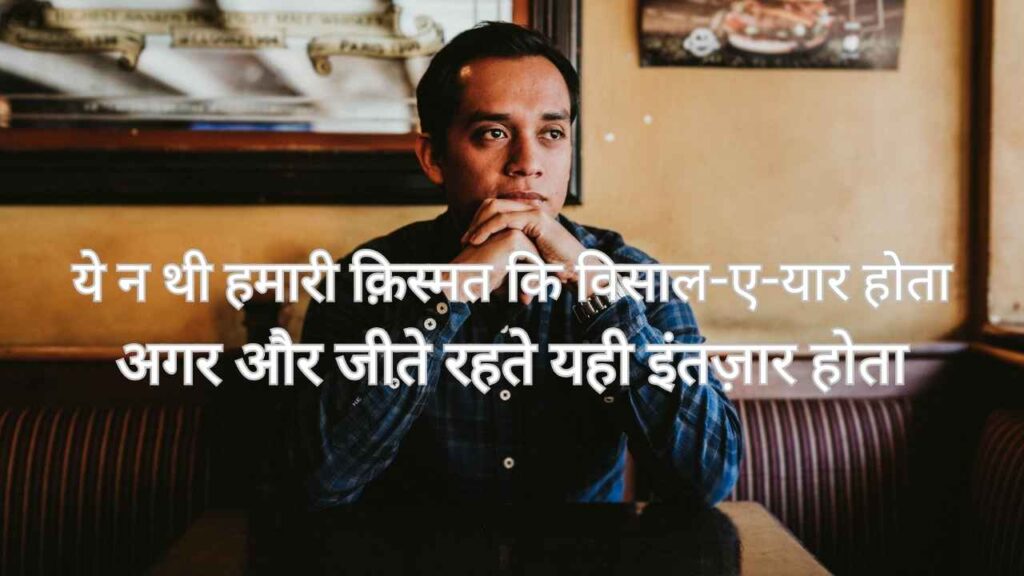
ये न थी हमारी क़िस्मत कि विसाल-ए-यार होता
अगर और जीते रहते यही इंतज़ार होता
Ye na thi hamari qismat ke visaal-e-yaar hota
Agar aur jeete rahte yahi intezaar hota
TRANSLATION
It was not in my destiny to be united with my beloved. Had I gone on living longer, this same waiting is all there would have been.
EXPLANATION
This is the opening couplet of one of Ghalib’s most profound ghazals on love and fate, and it sets a tone of resigned, clear-eyed despair. “Visaal-e-yaar” means union with the beloved, the supreme goal of the lover. The first line states flatly that such union was never written in his fortune.
The real brilliance is in the second line. Most lovers console themselves that with more time, things might have worked out. Ghalib demolishes that comfort: even if he had lived longer, the only thing waiting for him would have been more waiting. The future holds not eventual union but an endless extension of the same longing.
This is a remarkably bleak and mature insight. It strips away the hope that time itself contains. For Ghalib, the problem is not that he ran out of time, but that union was structurally impossible — more life would simply have meant more of the same fruitless yearning, not a different outcome.
There is also a metaphysical reading common in classical interpretation. The “beloved” can be understood as the Divine, and “visaal” as union with God. In that reading, the couplet becomes about the soul’s perpetual separation from the divine in earthly existence — a separation that no amount of living can resolve, only death can.
What elevates the verse is how calmly it is stated. There is no wailing, no rebellion against fate. It is the voice of someone who has thought the matter all the way through and arrived at acceptance. That quiet, almost philosophical surrender — more devastating than any outburst — is precisely what makes Ghalib’s treatment of heartbreak feel adult and timeless.