
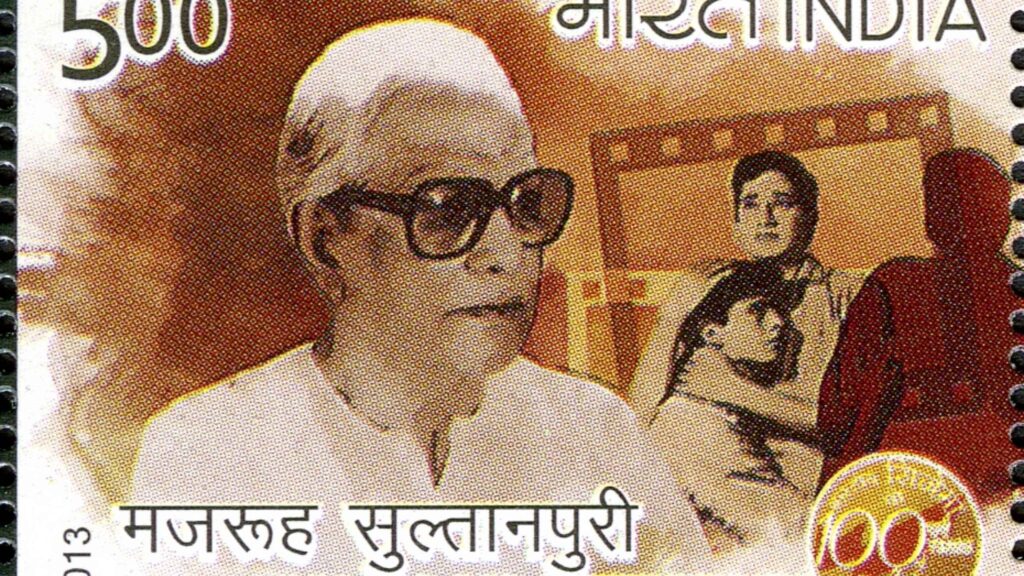
An original profile written for sheroshayri.com — followed by a collection of original shayari composed in his spirit.
A poet who chose his own name
Few poets carry their whole philosophy inside their name. Asrar ul Hassan Khan, born on 1 October 1919 in Sultanpur, Uttar Pradesh, picked the pen name Majrooh — “the wounded one.” It was not self-pity. For Majrooh, the wound was the credential of a feeling heart: proof that a person had loved, lost, fought, and stayed soft enough to keep bleeding. Across six decades he turned that idea into a career, becoming at once one of the twentieth century’s most respected Urdu poets and the most enduring lyricist Hindi cinema has known.
From the madrasa to medicine to the mushaira
Majrooh’s father was a policeman who distrusted English schooling, so the boy was raised on Arabic, Persian, and Urdu in a madrasa, then trained as a hakim in the Unani system of medicine. He was meant to heal bodies. But a struggling young physician who recited a ghazal one evening at a local mushaira discovered something inconvenient: the room loved his verse far more than his town needed his clinic. He set the stethoscope aside and gave himself to poetry, eventually becoming a shagird — a disciple — of the great Jigar Moradabadi, whose mentorship opened the doors of the wider literary world.
A reluctant entry into films
The cinema did not seduce Majrooh; it had to persuade him. When the filmmaker A. R. Kardar sought a lyricist, Majrooh nearly refused, holding the popular screen in low regard. It was Jigar who talked him round with a plainly practical argument: films would pay, and a household needs feeding. The composer Naushad then put him to a test, handing him a tune and asking for words to fit its meter. Majrooh passed, and with Shahjehan (1946) a sixty-year run began — one that would eventually touch hundreds of films and thousands of songs.
The price of conviction
Majrooh belonged to the Progressive Writers’ Movement, that remarkable generation of left-leaning Urdu writers — Sahir Ludhianvi, Kaifi Azmi, Ali Sardar Jafri, Jan Nisar Akhtar — who believed poetry should answer to society, not merely to the heart. His convictions were not decorative. In the years around 1949, at a workers’ gathering, he recited verses sharply critical of Prime Minister Jawaharlal Nehru. Ordered to apologize in exchange for his freedom, he refused, and served time in Mumbai’s Arthur Road Jail. His family was left in hardship; it was the young Raj Kapoor who, respecting the poet’s fierce self-regard, kept him afloat by commissioning songs rather than offering charity. That episode is the spine of Majrooh’s legend: a man who would rather sit in a cell than sign away a sentence he believed in.
Range without compromise
What makes Majrooh extraordinary is how little his integrity cost his versatility. He could write the aching ghazal and the bouncy dance number, the devotional and the flirtatious, and make each sound inevitable. He worked across eras and idioms — with Naushad and S. D. Burman, with R. D. Burman’s rock-and-roll energy, with Laxmikant–Pyarelal, and, late in his life, with a new generation in Anand–Milind and Jatin–Lalit, scoring hits for films as different in flavour as Dosti, Teesri Manzil, Yaadon Ki Baaraat, Abhimaan, Qayamat Se Qayamat Tak, and Jo Jeeta Wohi Sikandar. A devout Naushad once distanced himself after Majrooh’s turn toward communism; two decades later the two reconciled for Saathi (1968), and their families were eventually joined by marriage — a very Majrooh arc, in which estrangement bends back toward warmth.
What his poetry actually does
On the page, Majrooh’s gift was to keep the classical ghazal alive at a moment when many progressives dismissed it as ornamental. He didn’t abandon its symbols; he reloaded them. The candle, the wine, the rival, the road — old furniture of Urdu verse — became, in his hands, carriers of modern and political meaning, without ever losing their music. His most quoted couplet captures the optimism that runs through his work: the image of a man who sets out alone toward his goal and finds, gradually, that others have fallen into step behind him until a whole caravan has formed. That blend — solitary resolve ripening into shared hope — is the Majrooh signature.
Honours and afterlife
Recognition came steadily: the Filmfare Best Lyricist Award in 1965 for the unforgettable song from Dosti, the Ghalib Award in 1980, the Madhya Pradesh government’s Iqbal Samman in 1992, and, crowning them all, the Dadasaheb Phalke Award in 1993 — the first time Indian cinema’s highest honour went to a lyricist. He died in Mumbai on 24 May 2000, of respiratory failure, at the age of eighty.
Majrooh’s tragedy and triumph are the same fact. His film fame so eclipsed his literary standing that many never learned he was, first and last, a serious poet. But the verse endures because it does the rarest thing: it speaks the language of ordinary people while keeping the dignity of high art. The wounded one, it turns out, was the one who could heal.
Original Shayari — Written in His Spirit
Please note: The verses below are original compositions written in the romantic, resilient, and quietly defiant register that Majrooh Sultanpuri is loved for. They are not his own verses — his work remains under copyright — so everything here is free for you to publish on your site as original content. To read Majrooh’s actual ghazals legally, the best source is Rekhta (rekhta.org), which hosts his poetry with proper rights.
Each piece is given in Hindi (Devanagari), a Roman transliteration, an English translation, and a longer note on its meaning and craft.
I. इश्क़ और दीदार — Love & First Sight
1.
तेरा ज़िक्र आए तो लफ़्ज़ भी ठहर जाते हैं, जैसे शाम के परिंदे किसी शाख़ पे थम जाते हैं।
Tera zikr aaye to lafz bhi thahar jaate hain, / jaise shaam ke parinde kisi shaakh pe tham jaate hain.
English: When your name is spoken, even words come to a standstill — the way evening’s birds settle quietly upon a branch.
Note: The couplet treats the beloved’s mere mention as something that hushes language itself. The image of birds settling at dusk turns that silence into a homecoming rather than an awkward loss for words — speech folding its wings to rest. It sits squarely in the tradition Majrooh wrote in, where restraint says more than declaration.
2.
निगाह तेरी पड़ी और मौसम बदल गया, ये कौन कहता है बहार आती है बारी-बारी से?
Nigaah teri padi aur mausam badal gaya, / ye kaun kahta hai bahaar aati hai baari-baari se?
English: Your glance fell on me and the whole season turned — who was it that claimed spring only arrives in its own slow turn?
Note: Here love is given authority over nature’s calendar. The classical motif of bahaar (spring) is borrowed and then overruled: the beloved’s look does in an instant what the year takes months to do. The rhetorical question in the second line is the sher’s pivot, the gentle boast of a lover who has felt time bend.
3.
मैं ने माँगा था बस इतना कि तू सामने रहे, दुआ छोटी थी मगर उम्र भर की थी।
Maine maanga tha bas itna ki tu saamne rahe, / dua chhoti thi magar umr bhar ki thi.
English: All I ever asked for was this — that you stay before my eyes; a small prayer, but one meant to last a lifetime.
Note: The power of the couplet lies in the gap between “small” and “lifelong.” A modest wish is revealed, in the second line, to be the most demanding wish of all. It captures love’s particular arithmetic, in which the simplest request — mere presence — quietly outweighs every grander desire.
4.
तेरे आने की आहट से दर खुलते रहे, हम तमाम रात उसी एक धोखे में जीते रहे।
Tere aane ki aahat se dar khulte rahe, / hum tamaam raat usi ek dhoke mein jeete rahe.
English: A sound like your arrival kept opening the door; all night long I went on living inside that one sweet deception.
Note: This is the poetry of waiting, where the lover prefers a hopeful lie to a hopeless truth. Every small noise becomes the beloved’s footstep, and the heart willingly believes. The phrase “lived inside that deception” reframes self-delusion not as foolishness but as a survival strategy of longing.
5.
हुस्न को आईना दिखाने की ज़रूरत क्या, तू जिधर देख ले उधर रौशनी हो जाए।
Husn ko aaina dikhaane ki zaroorat kya, / tu jidhar dekh le udhar raushni ho jaaye.
English: What need has such beauty of a mirror? Wherever you choose to look, that very place fills with light.
Note: A classic praise-couplet that flatters by inversion: the beloved does not need a mirror because she is herself the source of light, not its reflection. The conceit makes her gaze active and creative — looking becomes illuminating. It is the kind of graceful exaggeration the ghazal form was built to carry.
II. हिज्र और जुदाई — Separation & Heartbreak
6.
जुदाई की भी अपनी एक रिवायत है मियाँ, वो चला जाए तो भी साथ चला करता है।
Judaai ki bhi apni ek riwaayat hai miyaan, / wo chala jaaye to bhi saath chala karta hai.
English: Even parting keeps its own old custom, friend — the one who leaves still, somehow, keeps walking beside you.
Note: Separation is personified as something with manners and traditions of its own. The paradox in the second line — the absent one remaining a companion — names the strange afterlife of love, where memory walks where the person no longer does. The colloquial “miyaan” gives it the warmth of spoken confidence rather than lament.
7.
दिल टूटा तो आवाज़ तलक न आई, कुछ चीज़ें बड़ी ख़ामोशी से बिखरा करती हैं।
Dil toota to aawaaz talak na aayi, / kuchh cheezein badi khaamoshi se bikhra karti hain.
English: When the heart broke, not even a sound escaped — some things come apart in utter silence.
Note: The couplet contrasts the violence of “breaking” with the quiet of how it actually happens. Real grief, it suggests, is undramatic; the largest collapses make no noise. That restraint — pain that refuses spectacle — is itself a kind of dignity.
8.
तेरे बग़ैर भी कट जाएगी, ये सच है, मगर हर रात पूछेगी कि वो कहाँ गया।
Tere baghair bhi kat jaayegi, ye sach hai, / magar har raat poochhegi ki wo kahaan gaya.
English: Yes, life will pass even without you — that much is true; but every night will go on asking where you have gone.
Note: The first line concedes survival; the second reveals its cost. By making the nights themselves the questioner, the verse externalises the ache — it is not the speaker who can’t stop asking, but time itself. It honours the truth that one can endure a loss and still be haunted by it nightly.
9.
रुख़्सत के वक़्त हँस के कहा था — जाओ ख़ुश रहो, और फिर उम्र भर उसी एक झूठ को निभाते रहे।
Rukhsat ke waqt hans ke kaha tha — jaao khush raho, / aur phir umr bhar usi ek jhoot ko nibhaate rahe.
English: At the parting I smiled and said, “Go, be happy” — then spent a lifetime keeping faith with that one lie.
Note: This is the poetry of noble sacrifice, the lover who hides his devastation to free the beloved. The smile and the blessing are a performance; the truth is the long ache underneath. “Keeping faith with a lie” is the sher’s masterstroke — loyalty turned, heartbreakingly, toward one’s own pretence.
10.
वो शहर छोड़ गया तो दीवारें भी उदास हैं, अब तो हवा भी उसी का पता पूछती है।
Wo shahr chhod gaya to deewaarein bhi udaas hain, / ab to hawa bhi usi ka pata poochhti hai.
English: Since they left the city, even the walls are forlorn; now even the wind goes about asking for their address.
Note: The grief here is so large it spills out of the speaker and stains the whole town. Walls and wind take on the mood the lover cannot contain — a use of pathetic fallacy that makes absence feel public, atmospheric, inescapable. The searching wind is a lovely final image: longing that wanders the streets looking for a home it has lost.
III. उम्मीद और हौसला — Hope & Defiance
11.
टूट कर भी जो दिल मुस्कुराना न छोड़े, वही तो चराग़ है जो आँधी में भी जलता है।
Toot kar bhi jo dil muskuraana na chhode, / wahi to charaagh hai jo aandhi mein bhi jalta hai.
English: The heart that keeps smiling even after it breaks — that is the very lamp which goes on burning through the storm.
Note: A resilience sher in the truest Majrooh mood. The broken heart is recast not as a ruin but as a flame that defies the wind, turning pain into proof of endurance. The lamp-in-the-storm is a classic Urdu image of hope under pressure — the quietly defiant optimism that runs through so much of his work.
12.
अँधेरा कितना भी गहरा हो, सहर आती है, ये रात अपने ही दामन में रौशनी रखती है।
Andhera kitna bhi gehra ho, sahar aati hai, / ye raat apne hi daaman mein raushni rakhti hai.
English: However deep the darkness, the dawn still comes; this night carries the morning’s light folded into its own lap.
Note: The consolation here is structural, not sentimental: night is not the enemy of light but its keeper, holding dawn within itself. The image of the night cradling the morning in its daaman (the hem or lap of a garment) makes hope something tender and maternal rather than merely inevitable. It is despair shown to be already pregnant with relief.
13.
गिरे हैं तो उठने का हुनर भी सीख लेंगे, ये ज़मीन हमें चलना सिखाने को झुकी है।
Gire hain to uthne ka hunar bhi seekh lenge, / ye zameen hamein chalna sikhaane ko jhuki hai.
English: If we have fallen, we’ll learn the craft of rising too; the ground only stooped to us to teach us how to walk.
Note: Failure is reframed as instruction. The clever turn is in the second line, where the fall — usually humiliating — is reinterpreted as the earth bending down like a patient teacher. It is an optimism that doesn’t deny the fall but refuses to read it as defeat.
14.
हर ज़ख़्म को मैं ने तमग़ा बना लिया, जो वार बचा न सका, वो भी काम आ गया।
Har zakhm ko maine tamgha bana liya, / jo waar bacha na saka, wo bhi kaam aa gaya.
English: I have turned each wound into a medal of mine; even the blow I couldn’t dodge has served me in the end.
Note: This couplet leans directly into the meaning of the name Majrooh, “the wounded one” — wounds worn as honours rather than hidden as shame. The second line is its quiet triumph: nothing is wasted, not even the strikes that landed. It is the philosophy of a survivor who has made his scars into a résumé.
15.
तूफ़ान से कह दो कि रास्ता वो दिखाए, हम तो डूब कर भी किनारा बना लेते हैं।
Toofaan se kah do ki raasta wo dikhaaye, / hum to doob kar bhi kinaara bana lete hain.
English: Tell the storm to go ahead and show us the way; even by drowning, we know how to become a shore.
Note: Defiance reaches its peak here: the storm is challenged, not feared. The astonishing final image — drowning in order to become a shore — suggests a self-sacrifice that turns one’s own ruin into safety for others. It is bravado raised to the level of generosity.
IV. तन्हाई और तलाश — Solitude & the Search
16.
तन्हाई से मैं ने कभी शिकायत नहीं की, यही तो वो आईना है जिसमें मैं साफ़ दिखता हूँ।
Tanhaai se maine kabhi shikaayat nahin ki, / yahi to wo aaina hai jismein main saaf dikhta hoon.
English: I have never once complained against my solitude; it is the one mirror in which I see myself clearly.
Note: Loneliness is reclaimed as a gift rather than a wound. The metaphor of solitude as a mirror suggests that only away from the crowd can a person see his true face. It quietly argues that self-knowledge needs silence — a thought as much spiritual as it is romantic.
17.
मंज़िलें पूछती रहीं — कब आओगे, मैं रास्तों से बातें करता रह गया।
Manzilein poochhti rahin — kab aaoge, / main raaston se baatein karta rah gaya.
English: The destinations kept asking, “When will you arrive?” — and I stayed back, lost in conversation with the roads.
Note: The couplet gently overturns the usual hierarchy of goal over journey. The destinations grow impatient while the traveller, unhurried, finds the road itself worth talking to. It is a meditation on living in the process rather than racing to the end — wisdom dressed as charming distraction.
18.
मैं ने ख़ुद को ढूँढ़ा हर एक चेहरे में, और हर बार किसी और से मुलाक़ात हुई।
Maine khud ko dhoondha har ek chehre mein, / aur har baar kisi aur se mulaaqaat hui.
English: I searched for myself in every face I met, and every single time, met someone else instead.
Note: This is the ache of identity — looking outward for an inward thing and never quite finding it. There is loneliness in the line, but also a sly truth: perhaps the self is not waiting in others’ faces at all. The repetition of “every time” gives the search its weary, lifelong rhythm.
19.
भीड़ में भी वो अकेला ही रहा हमेशा, जिसने अपने दिल की सुननी सीख ली थी।
Bheed mein bhi wo akela hi raha hamesha, / jisne apne dil ki sunni seekh li thi.
English: Even in the crowd he always remained alone — the one who had learned to listen to his own heart.
Note: The verse names the cost of inner independence: those who follow their own conscience are often solitary even among many. But the tone is admiring, not pitying — this aloneness is the mark of a person who cannot be bought by the crowd. It carries an echo of Majrooh’s own refusal to bend to authority.
20.
चराग़ ले के निकलना पड़ा है अपने ही घर में, यहाँ अपनों के दरमियाँ भी अँधेरा बहुत है।
Charaagh le ke nikalna pada hai apne hi ghar mein, / yahaan apnon ke darmiyaan bhi andhera bahut hai.
English: I have had to walk my own house carrying a lamp; here, even among one’s own, the dark runs deep.
Note: The most painful estrangement, the couplet suggests, is the one that happens at home. Needing a lamp inside one’s own house turns a familiar place strange. It speaks to the loneliness of being misunderstood by the very people meant to know us best.
V. ज़िंदगी और फ़लसफ़ा — Life & Philosophy
21.
ज़िंदगी एक सफ़र है, ये सब कहते हैं, पर ये कोई नहीं कहता कि लौटना नहीं।
Zindagi ek safar hai, ye sab kahte hain, / par ye koi nahin kahta ki lautna nahin.
English: “Life is a journey” — that is what everyone says; but no one ever adds that there is no coming back.
Note: The couplet takes a worn proverb and sharpens its edge. By completing the cliché with the truth it usually omits — that this journey is one-way — it turns comfortable wisdom into a quiet memento mori. The effect is to make the reader value the road precisely because it cannot be retravelled.
22.
वक़्त सब को बराबर मिला है, मगर, कोई तराशता है, कोई गँवाता रहा।
Waqt sab ko baraabar mila hai, magar, / koi taraashta hai, koi ganwaata raha.
English: Time is handed out equally to all; yet some go on carving it, while others keep frittering it away.
Note: A verse about agency. The image of “carving” time, like a sculptor with stone, suggests that hours are raw material rather than fate. Its democratic premise — everyone gets the same allotment — makes the difference between lives a matter of what we do, not what we are given.
23.
जो बीत गई उसे याद कर के क्या रोना, वो कल भी आएगा जिसे आज कहते हो।
Jo beet gayi use yaad kar ke kya rona, / wo kal bhi aayega jise aaj kahte ho.
English: Why weep remembering what is already gone? What you call “today” will be a yesterday tomorrow too.
Note: The couplet folds time in on itself to argue for presence over regret. Mourning the past is shown to be doubly futile, since today is busy becoming the very past we will later mourn. It nudges the reader, gently, toward living in the moment that is still in hand.
24.
दौलत से ख़रीद लो भले सारा जहाँ, पर नींद वहीं आती है जहाँ सुकून हो।
Daulat se khareed lo bhale saara jahaan, / par neend wahin aati hai jahaan sukoon ho.
English: Go ahead and buy the entire world with your wealth — but sleep comes only where there is peace of mind.
Note: A plain-spoken verse in the moralist tradition, contrasting riches with rest. Sleep becomes the test that money fails: the one thing that cannot be purchased, only earned through contentment. Its simplicity is deliberate — wisdom meant for the many, not the few.
25.
हर शख़्स यहाँ अपनी कहानी लिए फिरता है, तू जिसे भीड़ कहता है, वो सौ अफ़साने हैं।
Har shakhs yahaan apni kahaani liye phirta hai, / tu jise bheed kahta hai, wo sau afsaane hain.
English: Every person here wanders carrying his own story; what you dismiss as a crowd is a hundred untold tales.
Note: This is the most “Majrooh” of the philosophical verses, insisting on the dignity of ordinary people. The crowd — usually faceless — is reimagined as a gathering of individual epics. It carries the Progressive Writers’ belief that the common person is not a backdrop but the true subject of art.
VI. बग़ावत और ज़माना — Defiance & the World
26.
सच कहने की सज़ा अगर ये है तो मंज़ूर, हम जेल की दीवार पे भी ग़ज़ल लिख देंगे।
Sach kahne ki sazaa agar ye hai to manzoor, / hum jail ki deewaar pe bhi ghazal likh denge.
English: If this is the punishment for speaking the truth, then so be it — we will write our ghazal even on the prison wall.
Note: This verse is a deliberate salute to Majrooh’s own life, when he chose jail over an apology he did not mean. It frames imprisonment not as a silencing but as merely a new, harder surface to write on. The defiance is artistic as much as political: you can cage the poet, but not the poem.
27.
हमें झुकना नहीं आता, ये कोई ऐब नहीं, दरख़्त वो हैं जो फल आने पे झुका करते हैं।
Hamein jhukna nahin aata, ye koi aib nahin, / darakht wo hain jo phal aane pe jhuka karte hain.
English: We do not know how to bow — and that is no failing; it is the trees laden with fruit that stoop.
Note: The couplet plays cleverly against a familiar proverb (the fruitful tree bends low in humility) and gives it a proud counter-reading. Not bowing, the speaker argues, is its own kind of honesty for one who carries no false sweetness. The tension between dignity and humility is left bracingly unresolved.
28.
ज़माना उँगली उठाए तो उठाने दो, जो अपने पैरों पे चलता है, वो रुका नहीं करता।
Zamaana ungli uthaaye to uthaane do, / jo apne pairon pe chalta hai, wo ruka nahin karta.
English: Let the world raise its finger if it likes; the one who walks on his own feet does not come to a halt.
Note: A verse about ignoring the noise of judgement. The pointing finger of “the world” is dismissed with a shrug, while self-reliance — walking on one’s own feet — becomes the answer to disapproval. It is the creed of anyone who has chosen an unpopular path and kept moving.
29.
हमारी ख़ामोशी को कमज़ोरी न समझ, ये वो दरिया है जो किनारे तोड़ सकता है।
Hamaari khaamoshi ko kamzori na samajh, / ye wo dariya hai jo kinaare tod sakta hai.
English: Do not mistake our silence for weakness; this is the kind of river that can break its own banks.
Note: Restraint, the couplet warns, is not the same as helplessness. The river holds within its quiet the power to flood — calm on the surface, immense beneath. It is the unmistakable voice of the patient rebel, and it pairs naturally with the progressive politics that shaped Majrooh’s generation.
30.
जिस दिन ग़रीब की भूख ने ली अंगड़ाई, तेरे महल की हर ईंट हिसाब माँगेगी।
Jis din ghareeb ki bhookh ne li angdaai, / tere mahal ki har eent hisaab maangegi.
English: The day the hunger of the poor finally stirs and stretches awake, every last brick of your palace will demand its reckoning.
Note: This closing verse channels the social conscience of the Progressive Writers’ Movement most openly. Hunger is personified as a sleeping force that will one day wake, and the palace — built, by implication, on others’ want — is put on notice. It ends the collection on Majrooh’s most political note: poetry as a quiet warning on behalf of the powerless.