
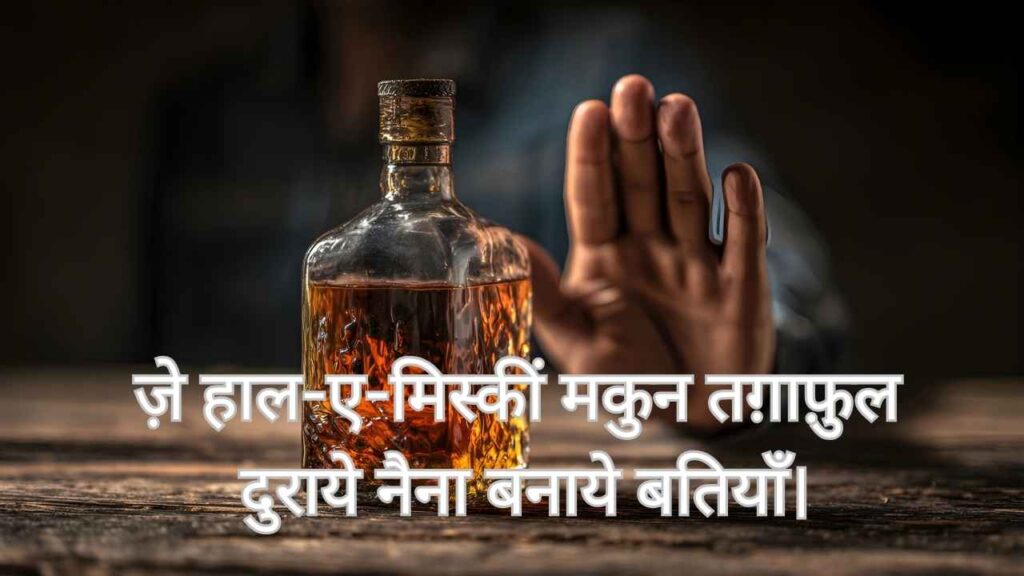
ज़े हाल-ए-मिस्कीं मकुन तग़ाफ़ुल,
दुराये नैना बनाये बतियाँ।
Ze-haal-e-miskeen makun taghaaful,
duraaye naina banaaye batiyaan.
Translation:
“Do not be so heedless of the state of this wretched, lovelorn soul —
turning your eyes away and spinning excuses to avoid me.”
Description (what it is)
This is perhaps the most famous single couplet in the entire tradition of Hindustani poetry, composed by Amir Khusro (Abu’l Hasan Yamīn ud-Dīn Khusrau, 1253–1325), the towering poet, musician, and mystic of the Delhi Sultanate and disciple of the Sufi saint Nizamuddin Auliya. What makes this verse legendary is not just its beauty but its extraordinary construction. It is a macaronic (bilingual) couplet, meaning it deliberately alternates between two languages line by line — Persian and Hindavi (an early form of Braj Bhasha / Khari Boli that would evolve into Hindi-Urdu). The full couplet reads:
Ze-haal-e-miskeen makun taghaaful, duraaye naina banaaye batiyaan;
Ki taab-e-hijraan nadaaram ai jaan, na leho kaahe lagaaye chhatiyaan.
Read carefully; the pattern is astonishing: the first half of each line is in courtly Persian, and the second half is in earthy, spoken Hindavi — yet they flow as one seamless thought, in one meter, on one emotion. “Ze-haal-e-miskeen makun taghaaful” (Persian: do not neglect the condition of this poor one) melts directly into “duraaye naina banaaye batiyaan” (Hindavi: averting your eyes, making up chatter). The second line continues: “Ki taab-e-hijraan nadaaram ai jaan” (Persian: for I have no strength left to bear this separation, O my life) and closes with “na leho kaahe lagaaye chhatiyaan” (Hindavi: why do you not take me and hold me to your breast?).
The theme is the classic ache of the lover pleading with an indifferent beloved. The key word is taghaaful — a studied, deliberate indifference, the pretence of not noticing. The beloved avoids eye contact (duraaye naina) and deflects with small talk and excuses (banaaye batiyaan), while the lover, worn down by the pain of separation (hijr), begs simply to be embraced. On the Sufi plane, as with much of Khusro’s verse, the “beloved” is also the Divine, and the lover’s longing is the soul’s yearning for union with God.
Beyond its content, the couplet is a cultural landmark. It is one of the earliest and finest examples of the Ganga-Jamuni tehzeeb — the composite Indo-Persian civilization that Khusro helped forge, weaving the language of the Persian court together with the tongue of the Indian street. Khusro is often called the “father of Urdu” and the “voice of India” (Tuti-e-Hind, the Parrot of India), and this verse is Exhibit A for why. It shows a poet equally at home in two worlds, refusing to choose between them.
The couplet has never left living memory. It survives today because it is sung, not merely read — a staple of the qawwali and semi-classical repertoire, rendered by legends from Ustad Nusrat Fateh Ali Khan to countless dargah singers at Nizamuddin. That it can still move a listener seven centuries later, in a language-braided few people can fully parse, is the surest proof of its genius.
5 more shayaris in a similar vein
1. Amir Khusro (the same poet, the same theme of bewitching eyes)
छाप तिलक सब छीनी रे मोसे नैना मिलाइके।
Chhaap tilak sab chheeni re mose naina milaaike.
“You stole my very identity — my mark, my adornment — with a single meeting of the eyes.”
2. Mir Taqi Mir (the beloved who feigns ignorance — pure taghaaful)
पत्ता पत्ता बूटा बूटा हाल हमारा जाने है,
जाने न जाने गुल ही न जाने, बाग़ तो सारा जाने है।
Patta patta boota boota haal hamaara jaane hai,
jaane na jaane gul hi na jaane, baagh to saara jaane hai.
“Every leaf, every shrub knows my condition; only the flower (my beloved) pretends not to — though the whole garden knows it well.”
3. Daagh Dehlvi (the beloved half-hidden, neither hiding nor appearing)
ख़ूब पर्दा है कि चिलमन से लगे बैठे हैं,
साफ़ छुपते भी नहीं सामने आते भी नहीं।
Khoob parda hai ki chilman se lage baithe hain,
saaf chhupte bhi nahin saamne aate bhi nahin.
“What a veil this is — sitting just behind the curtain; neither wholly hidden nor willing to come before me.”
4. Momin Khan Momin (the ache of a beloved’s imagined nearness)
तुम मेरे पास होते हो गोया,
जब कोई दूसरा नहीं होता।
Tum mere paas hote ho goya,
jab koi doosra nahin hota.
“It is as though you are beside me — in every moment when no one else is near.”
5. Mirza Ghalib (longing that never reaches union)
ये न थी हमारी क़िस्मत कि विसाल-ए-यार होता,
अगर और जीते रहते यही इंतज़ार होता।
Ye na thi hamaari qismat ki visaal-e-yaar hota,
agar aur jeete rehte yahi intezaar hota.
“It was never my fate to be united with my beloved; had I lived longer, it would only have meant more waiting.”
Send the next sher whenever you’re ready.